
50 UP
How to slow down the aging clock with things that actually work by Tom Furman

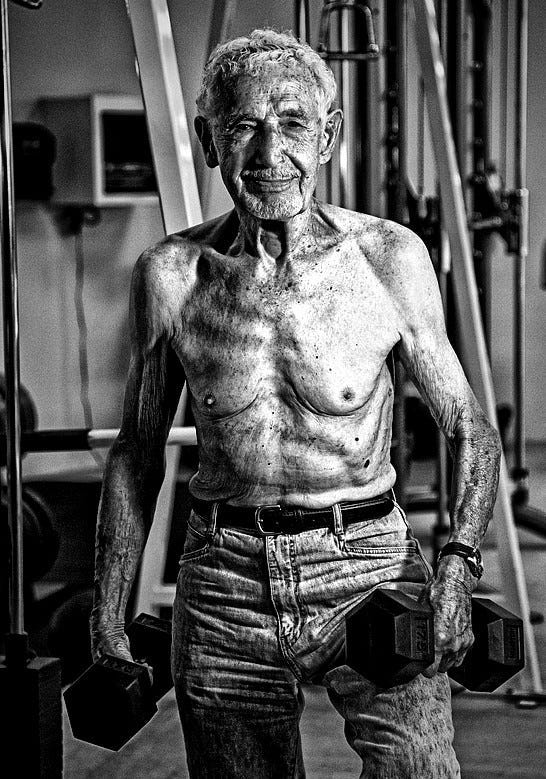
“Don’t Major in Minors.” ~ Jim Rohn
They often say that youth is wasted on the young. It’s something we joke about as we get to the age of 50 and up. It means that it would be wonderful to capture mature insight, experience and knowledge and inject them into a youthful body. That would be the best of times. Perhaps it would be the worst of times. No matter how thin you slice it, there are always two sides.
For many years people speak of longevity, “hacks”. Basically, a shortcut that is near magical that avoids the power of consistency and the proven value of work. Of course, this is an exercise in magical thinking. While we like to associate such thinking with children, this thought process is alive and well in adults. Consider the popularity of cold plunges, organic food, “longevity vitamins” and many other unproven modalities. Everyone is looking for some secret or magic to prolong life without actually putting in work or developing a potent habit of showing up.
Aging is a multifactorial issue. Focusing on one thing, as many books and social media influencers do, is avoiding the big picture. In fact, the most important things are often not even mentioned. Let’s list the bigger items and then develop a strategy to deal with them.
Avoid falls.
Lots of injuries leading to disabilities and a downward spiral of life occur because of falls. One in four seniors suffer from falls. Women fall more frequently and men die more often from falls.
Get cancer screenings.
90% of cancer deaths occur in those over age 50.
Get your blood pressure, heart and blood lipids checked regularly.
82% of heart disease deaths are in the more senior age groups.
Get a yearly check of your hormone levels and seek the best advice about keeping them normalized for proper vitality.
Use seatbelts.
50% of all passenger vehicle fatalities are from unbuckled occupants.
Floss.
Those who don’t, have a 30% higher rate of death.
Avoid sun tans and especially sunburns. Ultraviolet radiation is a Group 1 carcinogen. A tan is not adequate protection. It is however, a sign of damage and aging. The damage precedes the minimal protection.
Don’t smoke.
This goes without saying. No one wants to hear your anecdote about some ancient relative who did. No one cares.
Avoid entirely or greatly minimize alcohol. Similar to ultraviolet radiation and cigarette smoke, alcohol is a Group 1 carcinogen. It’s at the top of the heap. While small amounts of red wine may be associated with some minute positive changes in health, the evidence is not robust.
Combining prolonged sun exposure with alcohol is a risk that becomes multiplicative rather than addictive. When you add in smoking — well, do the math.
Get stronger and more muscular.
Regular strength training may be one of the most potent activities that you can participate in. Consistency and proper training methodology are of utmost importance. Everyone — everyone should strength train.
Participate in aerobic exercise.
Steady state cardiovascular exercise builds a healthy heart and has a positive effect on blood chemistry. When exercising, use a full range of motion or supplement strength training with stretching, during or after training.
Get proper medical care that is consistent with your general health and health conditions. Don’t theorize that medical care or pharmacology is bad. It’s one of the reasons we live longer, period.
Recover adequately from exercise or any stress. That means proper sleep and basic, healthy habits like hand washing and avoiding airborne disease, (coughing, sneezing).
Eat a Mediterranean-based diet with adequate vegetables, fruits, grains, seafood and leaner sources of protein. Healthy fats from monounsaturated sources like olive oil and avocados.
Maintain an optimal weight.
That means carrying minimal body fat. Measure and record your waistline and bodyweight. For women, the hips and waist can be used along with body weight. Weight is usually gained over the holidays and never lost. It accumulates over the years, so being 30–50 lbs overweight is quite easy after a few decades. 7 out of 10 people over the age of 50 are over fat.
Socialize and learn new skills.
This is for brain health.
The items above may seem like common sense, but apparently “common sense” is not too common. Most of the suggestions aren’t expensive or exotic and well within the reach of everyone.
Aligning with the idea of not majoring in minors, let’s avoid any discussion of unproven food supplements, off label drugs, and bogus items like energy healers. We can take hold of the more substantial tools like diet and exercise.
Proper aerobic exercise maintains a strong cardiovascular system as well as providing a healthy calorie burning mechanism. Strength training maintains and can add muscle size & strength. It stimulates healthy bones and connective tissue too. The loss of muscle mass that occurs as we get older is called, “Age- related sarcopenia.” Visually this is easy to detect in both men and women. When you add the gaining of ample body fat along with sun, tobacco and alcohol-related skin aging, that’s how we appear old.
Below are some rules for both strength and aerobic exercise.
Strength Training-
Plan for 2 workouts per week. Possibly 3.
The equipment is less important than proper form and progression.
Generally, start with the largest muscles and move toward the smaller ones through the length of the workout. Leg>Back>Chest, etc
Include exercises for the major body movements, Hinge, Squat, Pull, Push.
Movement should be smooth and not explosive, but not overly slow.
Exercising close to momentary muscular failure seems to be as effective as going all the way to muscular failure.
Hypertrophy or gaining muscle size is primarily a local phenomena. However multiple and single joint exercises both have great value.
Repetitions can be from 6–15 repetitions although when working towards failure, most repetition ranges are do-able.
Sets, if taken to failure, will be limited.
If an exercise is hurting you or seems overly awkward, use another. When athletes participate in strength sports they begin a romance with certain movements like bench pressing, deadlifting and barbell squatting. If you are not competing with these lifts and they do not agree with your physiology, use other modalities. Your workout should be based on safety and productivity and not sexual attraction to certain lifts.
Rest between sets should be 60 seconds or more. Lifting weights fast is not aerobic.
After each bodypart, there is belief that holding a 60 second stretch will improve muscle size. This is based on hazy evidence and “Gym Bro” anecdotes. If anything, it adds to the time under tension. However, I think it’s an easy way to rest between exercises that provides a healthy stretch of pre-exhausted muscles. It’s efficient. No yoga needed. Just stretch each body part after working near failure for a 60 second hold.
The abdominal muscles should be trained like any other muscle. Dynamically and as close to failure as possible.
Do not neglect your calves, forearms and neck.
If lower body training is exhausting, you may train just lower body one day and upper body the next. This is called, “Split” training. It would look like this:
Monday-Upper
Wednesday-Lower
Friday-Upper.
The next week flip to Lower-Upper-Lower.
To make strength training effective, it must be progressive. That means your body adapts to the stimulus by getting stronger. Therefore it must be challenged by a small increase in resistance when the repetition goal has been reached. This is what makes progressive strength training effective. It’s progressive. While this seems simplistic, most trainees forget this. They do a different workout every time or never record their workouts.
Piggybacking on the last point, every workout should be recorded in an analog fashion. Paper and ink make goals real. Apps don’t. Record your bodyweight, the date, the exercise, weight, repetitions and sets. Then, at the next workout, make the adjustments based on written evidence and not memory or an article that you read in Men’s Fitness.
Aerobic Training-
With strength training being abbreviated but potent, there is ample time to wind down with aerobic exercise. “Aerobic” means “with oxygen”. A simple rule is that you can maintain the work and still hold a conversation. This is an old, old rule and still applies. There is no need for expensive watches and apps. Simply taking your heart rate and using the same workload will clue you in on adaptation. When your pulse rate drops at the cessation of training with the same load and duration, it’s time to progress and increase the speed/resistance. I’m speaking here of using aerobic machines like upright bicycles, recumbant bicycles, ellipticals, rowers, arm ergometers and assault bikes. By using these modalities, adjustments are easy.
Depending on your available time, aerobic sessions can be from 10 to 60 minutes. The should require effort, but not be overwhelming. By becoming aerobically fit, you not only improve cardiovascular health, but improve your ability to recover from weight training. At the novice or average person level, there should be no down side to training aerobics after strength. For more advanced or competitive athletes, separating strength and cardiovascular sessions may be warranted.
If knowing your working heart rate is a game you like to stay motivated, search “Maffetone Training”, to get an appropriate range to stay in Zone 2 or conversational range.
Diet-
As I mentioned above in my list, the Mediterranean Diet comes out ahead in terms of the betterment of health, adherence, etc. Here is a bit of an addendum.
Consume at least one gram of protein per pound of target bodyweight. As we age our appetite for protein may drop and it’s necessary to keep it high to maintain our muscles and other body processes.
Lots of vegetables and fruits. This is a no brainer. If you are an adult and don’t like fruits and vegetables, grow up. Seek a wide variety of colors when purchasing.
Calories determine your bodyweight. It’s physics. Don’t rationalize your obesity, take action.
Vary your food intake. That means use variety as a tool to insure a wide variety of nutrients, vitamins, minerals and phytonutrients.
Minimize the consumption of saturated fat. Substitute monounsaturated fats which are heart healthy.
There is little evidence suggesting some magical food supplement that will increase healthspan and lifespan.
Simple additions can be Fish Oil, Magnesium, Creatine and Vitamin D. By all means get your Vitamin D levels measured and follow your physician’s recommendations for supplementation.
Don’t age your skin and get cancer by lengthy sunbathing sessions.
Coffee appears to have ample health benefits.
Avoid eating before bed since it can cause gastro issues.
Realize that along with these guidelines on bigger bang per buck methods to preserve healthy living past age 50, things still happen. Accidents, devastating disease and zombie apocalypses. Do your best and smell the roses.
The End.
For Online Fitness Coach or Zoom Consultation on fitness and exercise programming, contact me at Physicalstrategies@gmail.com
Tom Furman has been involved in martial arts and conditioning since 1972. With an early background in wrestling and a student of the methods of the York Barbell Club, Tom immediately separated fact from fiction growing up outside Pittsburgh. Eleven members of his family were combat veterans, the most famous one being “Uncle Charlie” (Charles Bronson) His down to earth training methods are derived from his decades long practice of martial arts and his study of exercise science. The application of force, improvement of movement and durability rank high on his list of priorities when training. He gives credit to hundreds of hours of seminars, training sessions, and ‘backyard’ workouts, including training time with many martial arts legends. He also credits his incredibly gifted training partners who came from varied backgrounds such as Exercise Physiologists, Airborne Rangers, Bounty Hunters, Boxing Trainers and Coast Guard Rescue Divers. Tom spent thirty years in the entertainment business and is currently a Fitness Consultant and Writer in Fort Lauderdale, Florida. His ebooks are available here.